
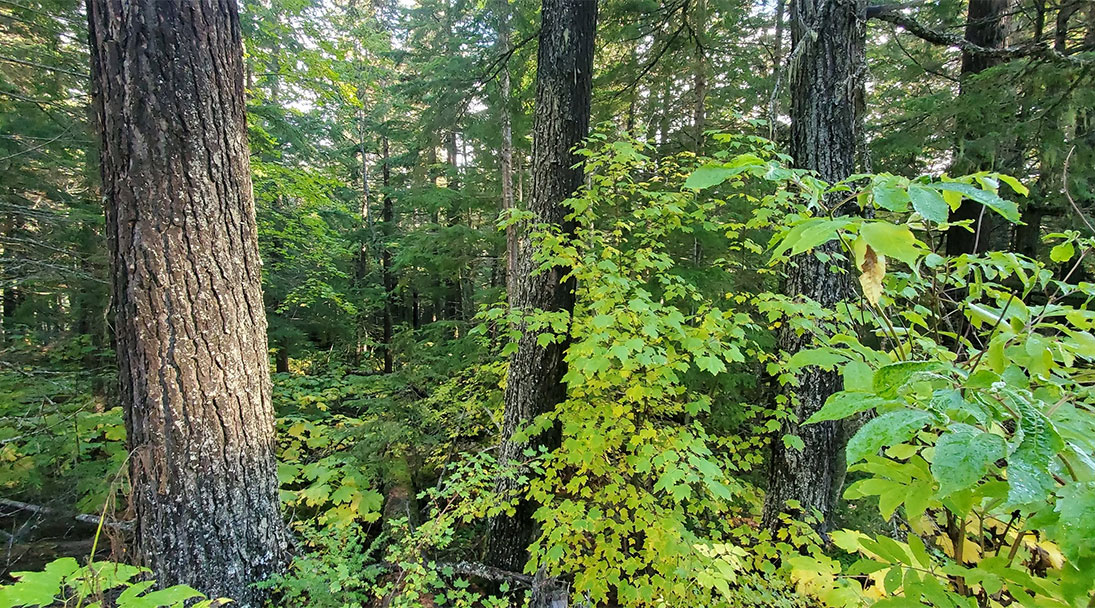
This is the response from Conservation North sent to the Forest Landscape Planning Branch on July 31, 2026.
Conservation North is a volunteer-based biodiversity advocacy group in north-central BC. With this letter we are providing comment on the Lakes Resiliency Forest Landscape Plan draft V1.6.
To sustain biodiversity over the long term, wildlife requires two things:
- enough natural habitat, and
- the ecological processes that maintain those habitats. Natural habitats build themselves using energy recycled in place over millennia. Habitat loss through degradation and conversion is the principal driver of declining biodiversity globally, and in British Columbia.
Enough Natural Habitat
This draft plan does not protect enough natural habitat to sustain biodiversity over the long term. It replaces old growth management areas and riparian corridors with a ‘biodiversity matrix’ that: a) does not protect enough natural habitat overall, b) includes previously logged areas, and c) offers no permanent protection. Some old growth management areas have also been ‘deleted’.
A 30% natural forest threshold is a well-known, critical conservation tipping point. When the amount of natural forest habitat remaining drops below this percentage, catastrophic declines in wildlife are imminent. This draft plan does not set aside 30% of representative primary forest (natural forest of any age) in serious protection; failure to this protection target places regional wildlife at extremely high risk of population collapse.
According to our analysis, 29% of the biodiversity matrix was previously logged. Degraded lands are inferior to natural ones in their ability to provide critical life requisites for wildlife. Primary old forests should be the highest priority for protection in the biodiversity matrix, especially given the regional needs of two key at-risk species : grizzly bear and northern goshawks.
Despite the disproportionate value of primary old forest for wildlife, the only objective for old forest in this draft plan is to “Support a full range of anthropogenic activities where the type and pattern of activity cycles across the landscape over time”(p. 40). High-quality reserves for wildlife need to be protected in perpetuity, not ‘moved’ around the landscape according to a logging schedule. This suggests a plan to wipe out primary forests, and the abundance and variety of life that depend on naturally functioning habitat.
The biodiversity matrix does not include any large contiguous areas that wide-ranging wildlife require, and there are no limitations on industrial activity like roads and logging. The biodiversity matrix allows logging to create fire breaks, and “management to address forest health concerns” (p. 37), which are both logging loopholes exploited to provide wood to mills. To date there are no examples of fire breaks effectively halting large fires in BC.
The ecological processes that maintain habitats
The draft plan ignores the ecological importance of natural disturbances to wildlife for this region. Fire, insects and other agents causing tree death perform a vital ecological function by cycling chemical energy in place, creating standing and fallen dead trees and other critical habitat for insects, birds, mammals and amphibians. Logging primary forests robs this chemical energy from the land and exports it out of the ecosystem, thereby diminishing long term habitat supply.
Old forests retain their ecological value even after a high-intensity fire. Some bird and insect species are adapted to high-intensity natural disturbances and require natural young forests. Even when fires occur outside of the historic range of natural variability, they do not harm ecosystems in the same way as the removal of forest by logging. Forests in the Lakes district are already structurally impoverished after nearly a century of indiscriminate logging, and the details of this ‘resiliency’ plan appear designed to further erode ecological integrity, and forest biodiversity.
The draft plan presents no information on historical reference conditions, which are needed for understanding what patterns of wildfire these regional wildlife are evolved to accommodate.
This draft plan perpetuates the erroneous myth that logging mimics natural disturbances (p. 23, 24, 25, 42 and 43). Logging and natural disturbances like beetles and fire have absolutely nothing in common. Natural disturbances are background processes that primary forests and wildlife evolved with over millennia. Logging is, in fact, a novel type of disturbance and the main driver behind habitat degradation.
The draft plan claims that normal ecological processes damage habitat and therefore require logging: “The pine beetle infestation in the project area required prompt salvage harvesting of the dead and damaged timber” (p. 96). The introduction claims that fires have “devastated forest ecosystems, and compromised biodiversity” while completely ignoring the actual damage caused by roads and logging. The draft plan avoids mention of industrial impacts until page 11.
This draft plan positions logging as a “solution” to fires and “forest health” factors (p. 3, 35), and seems to suggest that logging can be applied at a landscape scale to control fires. The draft plan then conveniently classifies a higher proportion of primary forest as being at “extreme” and “high risk” of burning than previously-logged forests. The bulk of the published fire science supports the opposite claim. As has been pointed out by ecologists familiar with the natural sub-boreal forests of the region, fires are limited not by ‘fuel’ (forests) but by the climate. This means that ‘reducing fuels’ (logging) won’t limit fire.
This draft plan claims that logging in wildland areas far away from settlements can reduce the risk of fire damage to private property and communities. In fact, the only way to protect property is through home hardening and defensible space pruning within 30 metres of structures. Despite confident claims throughout the document that logging can reduce fire risk, the authors admit that they have no idea how to accomplish this on page 101.
The most insidious claims made in the draft plan are that humans can “create healthy diverse forests” (p. 21) and that “Natural disturbance events are created through harvesting…(p. 36).” Humans are not God, and cannot “create” these systems, which have been perfected by time and evolution. We strongly encourage the authors of this report to familiarize themselves with the relevant ecological literature, and to solicit expertise from professionals competent in wildlife ecology and the determinants of biodiversity.
We believe that it’s the responsibility of the crown to protect wildlife conservatively, which means retaining at least 50% of natural forest habitat across ecosystem types. According to our numbers, only 48% of the Lakes Resiliency area is still primary forest, which means that even if all remaining natural habitats were protected from industrial activity, some restoration work would still be necessary to ensure the long-term maintenance of biodiversity.
This draft plan reads like a recipe for ecological collapse. It is reckless in its treatment of nature and of the published evidence. The Lakes Resilience FLP draft plan is not in the public’s best interest.
Sincerely,
Conservation North Steering Committee: Michelle Connolly, Cam Beck, Kate Logan, Jenn Matthews and Asta Glembotzki
Click here to download the letter in PDF Format.