
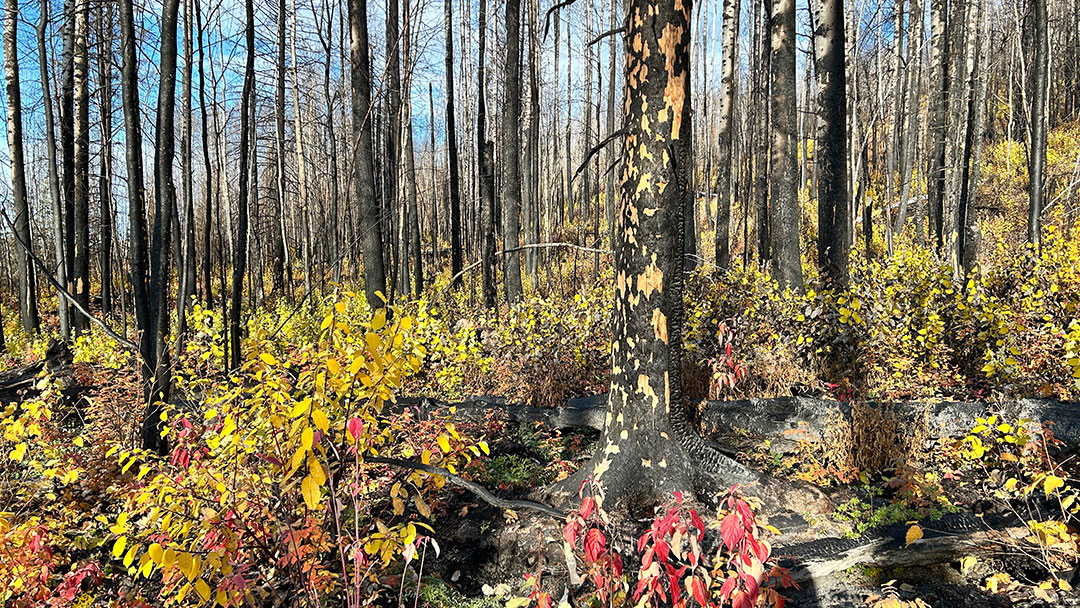
With this proposed legislation, the Ministry of Forests is expanding access to forests under the guise of “wildfire risk reduction.”
Prince George, B.C. – Textbook disaster capitalism. That’s how a forest advocacy group describes the Ministry of Forests’ Forest Statutes Amendment Act, a set of legislative changes to the Forests and Range Practices Act that aim to facilitate even more logging of the last primary forests in our province.
“As social license for continuing to log primary forests dries up, the Ministry of Forests doubles down, accelerating logging while claiming that BC is a global leader in sustainable forest practices,” says Jenn Matthews, speaking for Conservation North.
The Ministry of Forests is responsible for stewarding forests in British Columbia, but has received intense criticism for failing to shift to a system that recognizes the importance of retaining sufficient habitat for biodiversity. While other jurisdictions such as New Zealand and China have banned primary forest logging, BC continues to encourage the liquidation of these irreplaceable ecosystems.
With this proposed legislation, the Ministry of Forests is expanding access to forests under the guise of “wildfire risk reduction.” In fact, logging as an attempt to reduce fire risk can have the opposite effect, in some cases making forests more prone to higher severity fire. Discussing “wildfire risk reduction” logging recently, forest scientist David Lindenmayer stated that “its benefits are limited and its ecological and financial costs can be substantial.”
The proposed changes would also expand ‘salvage’ logging, a controversial practice where trees are harvested following a natural disturbance (wildfire or insect outbreak). “Salvage logging – especially in forests that have never been logged – damages soils, wildlife habitat, and water flows,” explains Conservation North’s director, ecologist Michelle Connolly. “Moreover, when you log after natural disturbance, you’re robbing the forest of key building blocks (including still-living trees) for the forest that will follow. The Ministry’s claim that this is forest stewardship is garbage.”
One change that is welcomed by some is the opportunity for commercial thinning in previously logged forests: “We support an expanded range of contracting opportunities in secondary forests, which were logged at some point in the past” explains Connolly. “Unfortunately, any pressure that is taken off of primary forests by this shift is put right back on by the threat of logging both before and after they burn. Both are disastrous for our beleaguered wildlife, and are a clear indication that this government has no intention of honouring its commitments to protect BC’s primary forests.”
Resource Link: https://www.sciencedirect.com/science/article/abs/pii/S000632072600056X?via%3Dihub
For more information, please contact:
Michelle Connolly, Conservation North
connolly@unbc.ca | 778.349.3667 | conservationnorth.org